


How do you picture the humans behind the push for AI literacy? At Hatch, our AI programmes team is female, young, and come from a diversity of backgrounds including marketing, engineering, and non-profit work - but what we think really sets them apart is their deep empathy, and ability to hold nuance and more than one perspective at a time.
Meet Sam and Shermain who oversee our flagship free AI literacy training AI Amplified - from curriculum design to learner experience and more.
What has your journey been like running AI literacy trainings?
Shermain
"I started my career as an engineer, so this is a very different space for me! The idea of AI and education was intriguing, and the notion of being on the ground with communities at Hatch drew me in. I was intrigued by how Hatch would approach AI literacy for a regular, non-technical person.
AI was a conversation everywhere - I saw it on a sector level in my previous job and now I see it on the ground level.
I used to learn about AI on a sectoral level - how might it transform for example, manufacturing, operations, processes - and a top down approach was the norm. Back then, AI was presented to me as a necessity to boost efficiency, ROI, productivity
On the ground here, there’s a big difference. We really believe in meeting learners where they are. It’s quite a contrast to an employer’s perspective.
Learners really appreciate that we do this bridging work - going down to the basics of what is an LLM, what does ATS stand for, and so on.
Being able to meet people from different walks of life has been life-changing for me!"
Sam
"I worked in social media and loyalty marketing previously, and left that life to start up my acai business soft spot. When I was reflecting on what I wanted to do next, I did a deep dive into what really matters to me. I realised it wasn’t so much about the job or the salary. It was about the impact I’m making, whether my efforts are helping someone else.
As I started my role running programmes and meeting people, I felt how impactful it was.
I had just been around corporate folks who were all about KPIs, revenue, milestones.
Here, it’s about so much more than just numbers. It really makes you think from a different perspective."

How have you witnessed AI being received on the ground?
Shermain
"Where we are, we get to see how it impacts every single person.
It didn’t hit me until we saw how students responded to AI. They look at their future and see AI consuming their jobs at such a fast pace. This nuance forces me to think very carefully about what we put out.
In the corporate world, you have users asking how can I use AI to be more productive… to get promoted?
With students, I had a 15 year old asking me, “Don’t you think it’s wrong to be teaching people about AI with it’s environmental impact?”
And we also see seniors fearing AI taking away their jobs; just Microsoft Word, is not enough to be tech-savvy.
We see so much of this. And I honestly, don’t feel qualified to give an answer to the 15 year old girl. The answer is so much bigger than all of us.
It’s good that she understands the cost of AI on the planet. But it’s also scary if you don’t know anything about AI and you’re looking for a job. There’s no right answer.
Our stance is not that AI is a blanket good, but if we don’t bridge the gaps so many people will be left behind.
Every time we do this programme, my view gets a bit sharper. There are uncomfortable conversations to be held, and Hatch has been trying to manoeuvre this, holding hands with those at risk of being left behind as this revolution is happening."

How do you translate that nuance into the AI Amplified curriculum?
Sam
"We work mostly with partners in the social service and education sectors, and some of them look to us as their go-to source for AI guidance. Our training is free, but I don’t think it’s just us doing it for free that they like. Clients enjoy working with us because they can tell how much heart we put into it, and that’s what keeps me going because I see and feel our impact whenever I meet learners on the ground. We will always try our best for each client, to customise a learning experience to fit their needs.
At the same time, we’re not afraid to talk about how AI is not for everyone - and that’s okay. A lot of courses feed you with AI - this is how you do this or that. We aim for a general understanding of what AI is, and supporting you on your own journey of using AI to build something if you want to.
We come with so much consideration for people’s feelings - we are there for them. With students for example, we’re not just feeding them information; we try to understand things from their point of view.
We get our team to share their life experience and relate to the learners - not just blast them with AI."
Shermain
"For someone who wants to start out in AI, many of the AI trainings out there focus on knowing the latest features, keeping updated with the newest models, and so on. But that information may not be for everybody.
On the other hand, I think our information is for everybody so that they don’t feel scared of AI, so they know how they remain valuable, how they can stay relevant with AI in the picture.
Our curriculum focuses on the human in the loop - the human to make decisions, do the thinking, intervene in the AI’s processes, use AI responsibly. It is not often that courses cover considerations of what you put out there, the risks, and how you can uniquely collaborate with AI without replacing yourself.
We are in a particularly special position to hold space for our learners - we want to create a safe space for them, and hold space for them to talk to us about their hopes and fears about AI."

How do you feel about the future?
Shermain
"Can I say that I feel excited and scared at the same time?
Technically, the advancement in AI is impressive on so many levels. For example in manufacturing, humans used to do defect checks: imagine that on a nano-scale, with naked eye and some possible tools. Now, with AI taking that on, engineers can focus on other stuff that is actually humanly possible.
It’s with these machines working overtime that you can do calculations faster. With cancer research, for example, there is so much potential for impact.
I’m optimistic about the future of AI if it’s used well, but it’s a double-edged sword so the future really depends on who’s holding the sword.
You'll start to see a lot of things you can’t stop - the studio Ghibli trend, the 80’s photo trend. If you don’t know better, you don’t realise what you’re doing. I used to dabble in learning about AI video tools before Hatch, and some, interestingly tied competency of the tool to howwe can make AI videos look more human - now it makes me uncomfortable. In less than a few months, that pursuit of human-like perfection video has led to for example, deepfakes that are harder to discern and the risk to vulnerable people exposed to this.
We’ve been using AI this whole time, but our dependency on AI now is scary. I can’t go somewhere new without Google Maps, or unlock my phone without facial recognition. AI's just so ingrained in everything.
At the same time, with the speed of AI developing, I’d rather be educated than left behind. But I would love to do that in a safe, guided space. For many navigating this space, they don’t see change on a sectoral level - they see job replacement. And there’s not much you can do about that but educate yourself."
Sam
"AI can feel exciting and daunting at the same time.
Used well, AI can do wonders, but used carelessly… we know this technology can cause real harm. That’s why learning about AI and how to use it safely to protect oneself matters now more than ever.
If you don’t learn about AI, you risk falling behind. At the very least, we should understand what AI is and what precautions we should take to protect our personal data.
What we can do is better educate ourselves and have fun learning in the process."
What is the most interesting part of your job?
Shermain
"The best part of my job here at Hatch is getting to be part of the 0-1 for learners. Being that safe space for them, introducing this “scary” new tech in ways that don’t make them feel overwhelmed. When you see the light in their face when they realise they could use AI more meaningfully or free up time, rather than consume AI microdramas. Teaching them how to fish rather than just riding the wave."
Sam
"I believe Hatch is in a position to be a voice for people who have concerns about AI. We work mostly with partners in the social service and education sectors, and some of them look to us as their go-to source for AI guidance.
We are not experts, we are still and always learning. There’s no real way to be an expert - the tools evolve all the time and advance so quickly - and that’s okay. It’s all about going at your own pace, and continuing on your own AI journey if you want to use it. Everyone’s journey is so different. If anything, AI should support your sense of agency; you get to define what AI is for you.
It’s funny - with AI in a way we try to be less human, but we care so much about each human."

Building our AI Compass: Navigating AI as a Social Business
In these times, developing our conscience, stance and framework around AI might be one of the most important things we do. So let's talk about it
Mission
Team
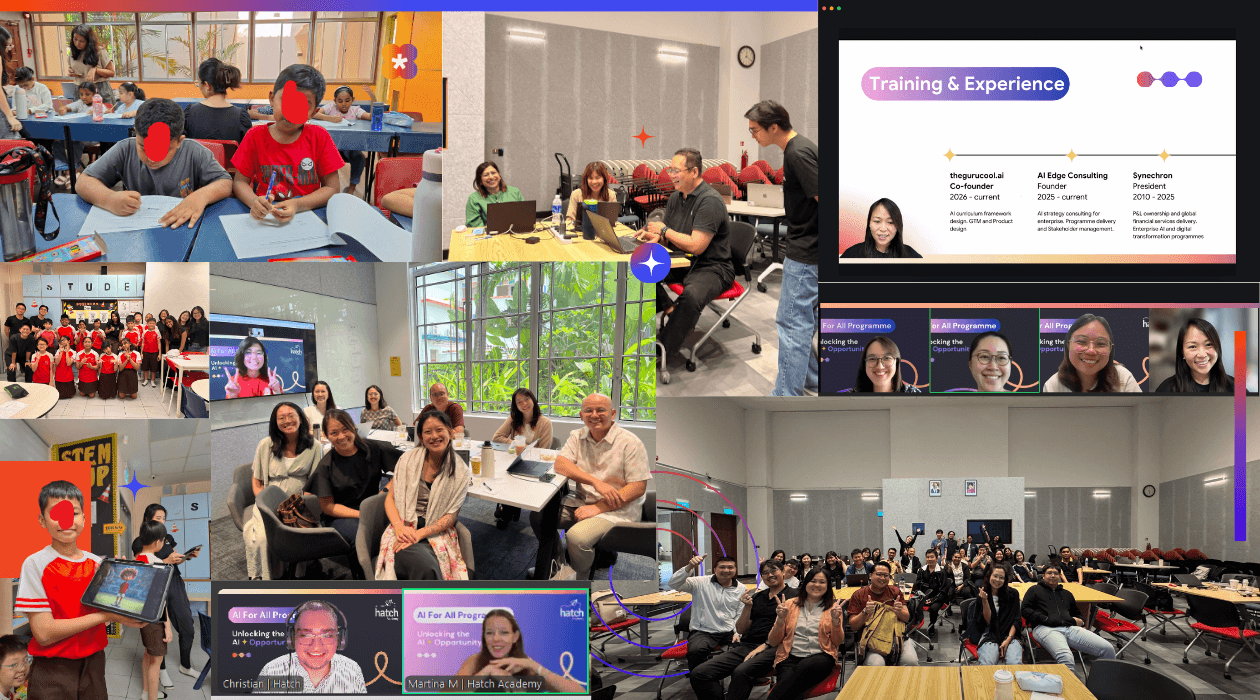
"Nothing is really free" - 5 things we learned from running AI literacy trainings
We've run AI literacy programmes for learners from all walks of life - here's what we've learned so far.
Product